Massive Permafrost Detachment Slides Reveal New Climate‑Driven Landscape Threat
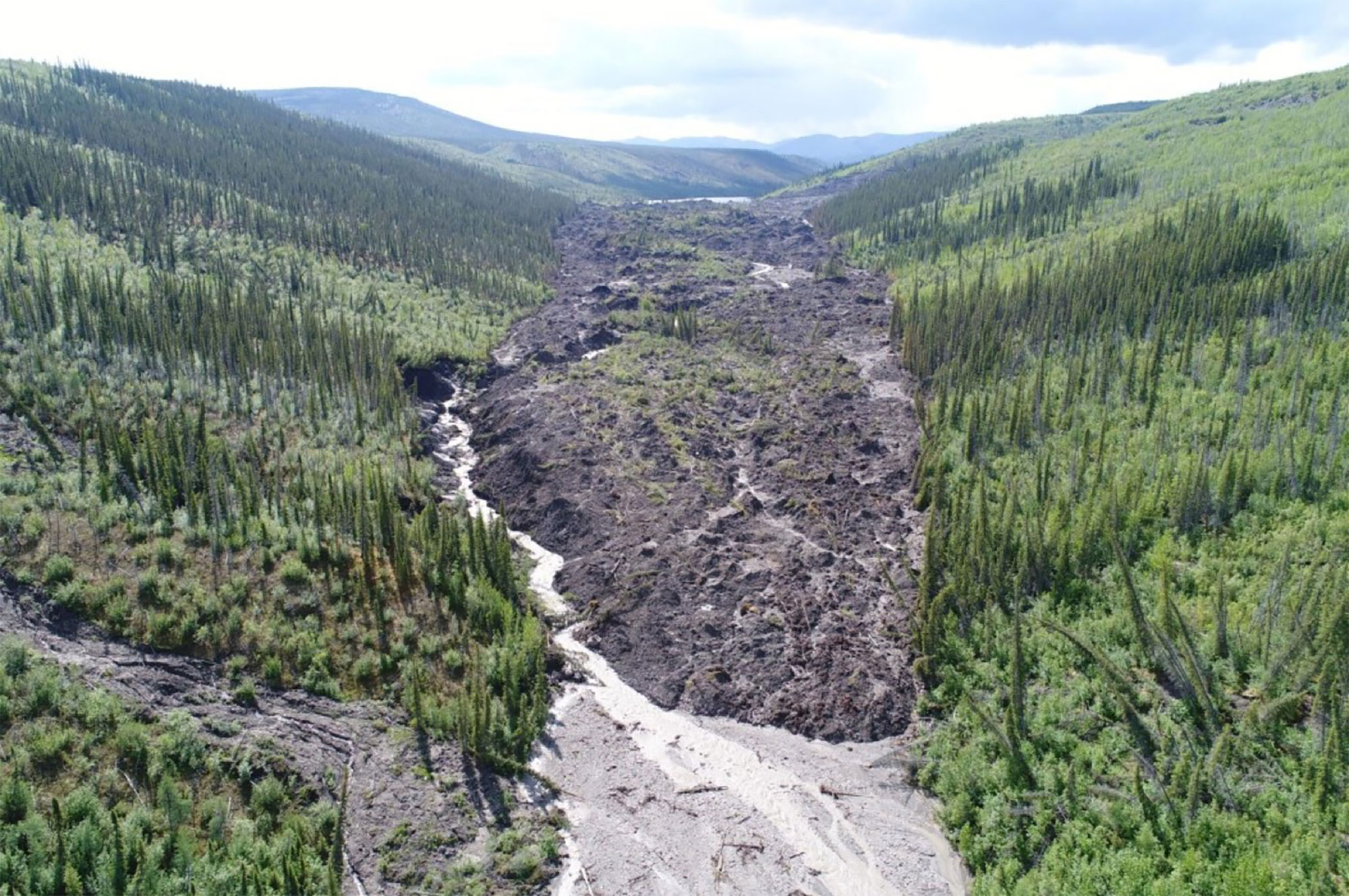
Researchers document unprecedented “permafrost detachment slides” in Canada’s Northwest Territories, linking them to warming and wildfire impacts.
Discovery of a New Slide Type
Nearly ten years ago a helicopter pilot over Canada’s Northwest Territories spotted a landslide that blocked a river and formed a lake. Researchers later identified the event as a “permafrost detachment slide,” a category not previously described in scientific literature.
Scale of the Recent Slides
In a new study, scientists detail two slides in the region—one extending roughly three‑quarters of a mile and another about two miles long. Together the slides displaced an estimated 30 million cubic yards of earth, far larger than typical landslides that transport rainwater, mud, and rock down slopes.
Field observations revealed massive frozen blocks up to 650 feet in length embedded within the slide material, indicating that the permafrost failed from below rather than from surface thaw.
Link to Wildfire and Permafrost Thaw
The destabilization began after a wildfire swept the area in 1995, burning the vegetation that normally shades the permafrost. Without this thermal shield, the ground’s temperature gradually rose, allowing a subtle heat signature to reach the permafrost base over the following decades.
Scientists explain that as the base warmed, tension cracks formed, creating surface pools of relatively warm water that further infiltrated the frozen ground. The permafrost slipped downhill at a slow rate that eventually accelerated, culminating in sudden detachment slides in 2017 along the Johnson River and in 2018 along the Redstone River.
Implications for Climate Feedbacks
When permafrost collapses, it exposes large walls of frozen material to sunlight, potentially triggering additional failures, according to lead author Joseph Young, a geoscientist at the University of Alberta.
Microbial activity in thawed organic material can release greenhouse gases, creating a feedback loop where warming accelerates permafrost loss, which in turn releases more carbon. Researchers such as Miriam Jones of the USGS highlight this as a major global concern.
Broader Context and Future Risks
Permafrost underlies an area two and a half times the size of the continental United States across the Northern Hemisphere. The Arctic is warming about four times faster than the global average, leading to phenomena like thermokarst—large ground depressions that emit greenhouse gases.
Scientists anticipate that as Arctic greening advances, increased shrub cover may trap snow, insulating the ground and hastening permafrost degradation. Additionally, peat‑fuelled “zombie fires” that persist underground through winter could further amplify carbon emissions.
While the exact contribution of permafrost detachment slides to atmospheric carbon remains unknown, the sheer size of these events suggests they could be a significant source, according to Young.
Looking Ahead
Experts such as David Olefeldt of the University of Alberta, who was not involved in the study, expect more discoveries of similar large‑scale permafrost failures as climate thresholds are crossed in vulnerable regions.
Understanding and monitoring these abrupt thaw events will be crucial for assessing future climate impacts and potential mitigation strategies.
This emerging slide type underscores how rapidly changing conditions in the Arctic are reshaping the planet’s frozen frontiers.