NASA Guidance on Evaluating Instrumented Hammer‑Tap Test Adequacy
A NASA technical brief outlines how to judge hammer‑tap tests by measuring complete force and response data rather than relying on waveform shape alone.
Background: What the Hammer Actually Measures
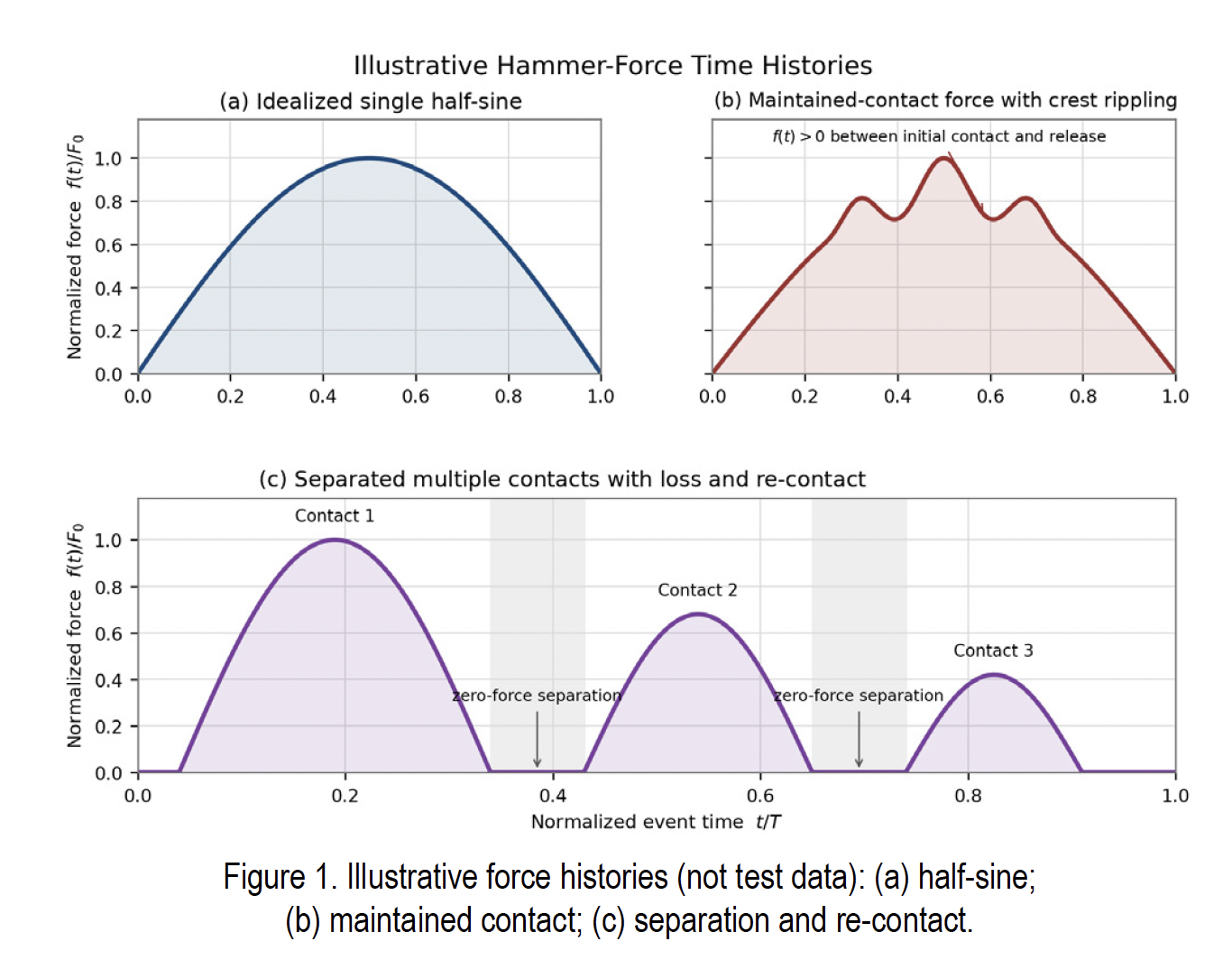
Instrumented hammer tests are used for modal analysis and can precede pyroshock testing. The brief compares three force histories: a half‑sine, a maintained‑contact rippling pulse, and a pulse with separated contacts. During a zero‑force interval, the structure continues to vibrate, and any re‑contact acts on that vibration. If an exact model and the test article receive the same force and initial conditions, the responses will be identical for each bounded measured history.
Analysis: A Half‑Sine Is Broadband, but Not Flat
Figure 2 in the source shows that a finite half‑sine contains spectral zeros at frequency ratios f/fo = 3, 5, 7, … where fo = 1/(2T) for pulse duration T. The presence of these zeros means the half‑sine alone cannot establish adequate excitation across all frequencies.
Analysis: Spectral Content Is Determined by the Measured Force History
Figure 3 normalizes each spectrum to its own DC value. Crest rippling adds spectral content and can fill the notches of a half‑sine. Timing between separated contacts creates deterministic interference. For adequacy, the unnormalized measured spectrum and the response signal‑to‑noise ratio must be inspected.
Recommended Practice: Evaluate Test Adequacy Against the Intended Objective
Measure the complete applied force with sufficient bandwidth, proper calibration, dynamic range, and accurate time synchronization.
Verify response measurements for adequate bandwidth and signal‑to‑noise ratio, ensuring they are not clipped or saturated.
Confirm excitation coverage of the frequency, amplitude, and nonlinear‑response ranges required by the test objective.
Reject or repeat a test only when a specific deficiency in measurement, excitation, or coverage is identified.
Conclusion
The visual appearance of a half‑sine pulse neither establishes validity nor guarantees adequacy. Each hammer test must be judged by its purpose and by accurate, complete force and response measurements over the required range.