Ten Eerie British Sites Worth a Halloween Pilgrimage
From a roofless folly in Sussex to a Cold War bunker turned museum, Britain hides a dozen spine‑chilling spots for the brave.
Racton Monument – The Ruined Folly of Sussex
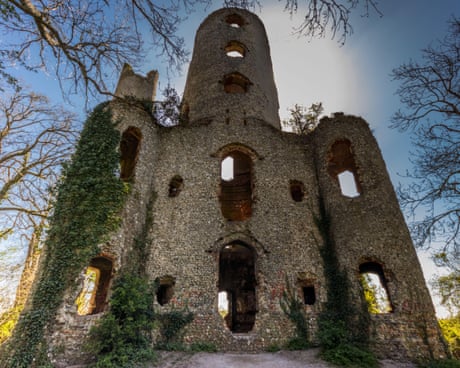
Outside Chichester, a 24‑metre tall redbrick and flint structure known locally as Racton Ruin dominates the horizon. Commissioned by George Montagu Dunk, the second Earl of Halifax, its purpose remains uncertain – some suggest a summerhouse, others a lookout for Solent traffic. The roofless shell is private property and unsafe to enter, yet it is visible from nearby footpaths. Paranormal investigators have reported a ghostly woman wandering the grounds and sudden bursts of manic laughter.
Pontsticill Reservoir – A Flooded Village Beneath the Water
Completed in 1927, the Pontsticill reservoir in the Brecon Beacons national park stores up to 15.5 billion litres of water for south Wales. Its bell‑mouth spillway resembles a giant plughole, an aesthetic echoed in other reservoirs such as Ladybower. When droughts expose the valley floor, the remains of a submerged village – including a 15th‑century church – can be seen. The site was featured in Richard Ayoade’s 2010 film Submarine.
Chetney Marshes – Decaying Barges on a Kentish Marsh
On the fringe of north Kent, Chetney Marshes bears names like Deadman’s Island, Slaughterhouse Point and Bedlam’s Bottom. The marsh is littered with rotting barges whose origins are disputed: Historic England lists them as former Thames barges, while older maps label them as Victorian prisoner‑transport ships. Their decay blends with the surrounding reeds, creating an atmosphere that feels otherworldly.
Kelvedon Hatch – The Bunker That Became a Museum
Built in the early 1950s, Kelvedon Hatch could shelter up to 600 military personnel, civilians and even the prime minister in a post‑apocalyptic scenario. Above ground it appears as an ordinary bungalow; below, a three‑storey underground complex the size of 25 average British homes. Today it operates as one of the world’s largest Cold War museums.
Singing Ringing Tree – A Wind‑Powered Sound Sculpture
Perched on a Pennine hill above Burnley, the three‑metre tall Singing Ringing Tree is a brutalist‑style steel sculpture by architects Mike Tonkin and Anna Liu. Its galvanized pipes are tuned to different pitches, producing discordant harmonics when the wind blows. It is one of four Panopticons, reimagined as public artworks rather than symbols of surveillance.
Hodge Close – The Slate Quarry That Looks Like a Skull
Hidden in the Tilberthwaite valley between Coniston and Langdale, Hodge Close is an abandoned slate quarry on National Trust land. In the right light the cave openings and dark pool suggest a skull, a visual cue familiar to fans of the Netflix series The Witcher. The site was abandoned in the 1960s and now bears industrial remnants that lend it a post‑civilisation feel.
Crossbones Graveyard – A Medieval Pauper Cemetery Near the Thames
South of the River Thames, close to Shakespeare’s Globe and the Shard, lies Crossbones Graveyard, once part of “The Liberty of the Clink”. It served as a burial ground for medieval sex workers and others denied Christian rites, with an estimated 15,000 interments. Reclaimed as a garden of remembrance, it opens for guided walks and talks at selected times.
Cateran Hole – A Smuggler’s Hideaway on Bewick Moor
Four miles north of Eglingham, deep in Bewick Moor, Cateran Hole is a 35‑metre underground chamber once used by bandits to hide contraband. The entrance is difficult to locate, and the tunnel narrows to a tight point with no safety barriers, lighting or warnings, offering a thrill for the intrepid.
Quorum – Stone Faces Watching the Galloway Hills
Just off Old Edinburgh Road in the Galloway Hills near Newton Stewart, artist Matt Baker carved a series of stone faces in 1997. Known as Quorum, the faces stare out from a drystone wall, their features now partially covered by lichen‑formed eyebrows. Nearby stands The Eye, a 10‑metre tall cone sculpture on the banks of Black Loch.
St Matthew’s Church on Rutland Water – A Lake‑Side Sanctuary
At the edge of Rutland Water, St Matthew’s Church sits on a boulder‑strewn promontory, appearing to rise from the lake on misty mornings. Built in the 1820s on the site of a medieval chapel, it was slated for demolition when the reservoir was created in the 1970s, but a public campaign saved it. The church is visible from the shoreline and opens on scheduled days and for private events.
Author Dave Hamilton, known for Weird Guide and Wild Ruins, compiled these locations, offering a roadmap for those who relish a touch of the macabre this Halloween.