AAUP Breaks Century‑Long Silence to Endorse Candidates, Defends Academic Freedom

The American Association of University Professors has for the first time in its history endorsed political candidates, arguing that such endorsements protect academic freedom.
AAUP’s First Political Endorsements Spark Debate
The American Association of University Professors (AAUP) has come under fire for endorsing political candidates in the upcoming midterm elections, marking the first time the century‑old organization has taken such a step.
Supporters argue that voting is inherently political and that unions routinely endorse candidates, so the AAUP’s action is consistent with its mission to protect higher education and free speech on campus.
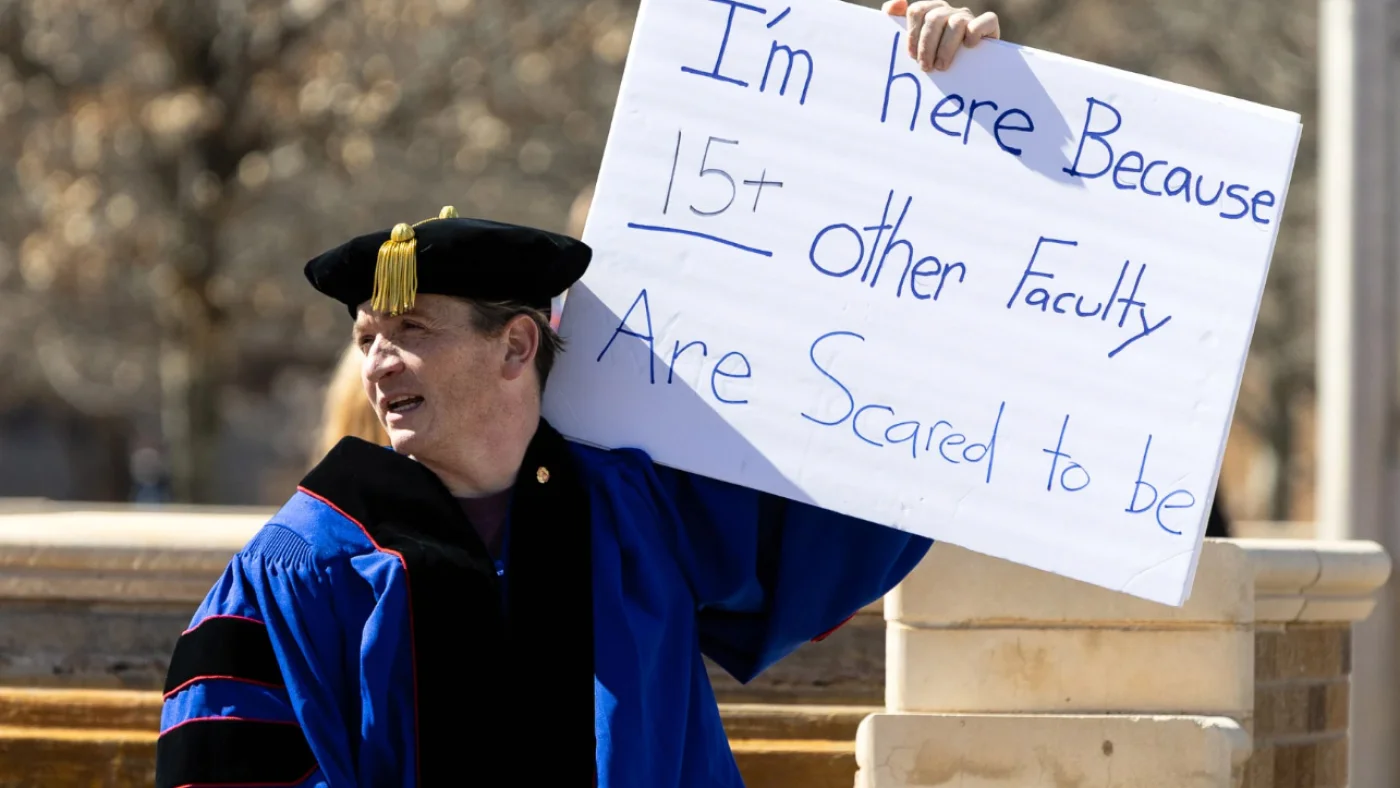
“Why shouldn’t the AAUP also speak out against the politicians who vote for and implement the laws that violate academic freedom?” the organization’s defenders ask.
Endorsements as a Defense of Core Values
Those who claim that political endorsements jeopardize the AAUP’s principles are described as mistaken; the endorsements are framed as the effective expression of the association’s dedication to academic freedom.
While some members may feel offended, the argument is made that many more would be upset if the AAUP remained silent amid what is called the worst attack on academic freedom in American history.
Indifference, the piece asserts, is itself a political stance—just a poorer one.
Critic Targets Academic Freedom’s Scope
Tammi Rossman‑Benjamin, director of the AMCHA Initiative, wrote an op‑ed in the Washington Times on Oct. 29 denouncing the AAUP’s endorsements and claiming that “Academic freedom was meant to protect scholarship from politics.”
The article rebuts this, stating that academic freedom protects scholarship by defending the right of academics to express political ideas.
Middle East Studies Association Under Fire
Rossman‑Benjamin also attacked the Middle East Studies Association for its Oct. 8 report “Lessons in Repression,” which documents nearly 200 incidents of alleged retaliation against university employees for pro‑Palestinian speech and activism, mostly outside the classroom.
She questioned how an organization devoted to Middle East scholarship could make defending political activism a major institutional project.
The response is that scholars have been attacked for their political views, and protecting scholarship requires protecting scholars’ right to express those views without retaliation.
No “Political Activism” Exception
The piece emphasizes that there is no exception for political activism within academic freedom; rather, the primary purpose of academic freedom is to defend professors accused of expressing unpopular political views.
Historical examples are cited: in 1894 the University of Wisconsin defended Richard Ely’s labor‑movement politics; in 1895 the University of Chicago fired Edward Bemis for criticizing railroad owners; in 1900 Stanford dismissed Edward Ross for his economic views; and in 1915 the University of Pennsylvania fired Scott Nearing for opposing child labor.
These cases helped shape the AAUP’s 1915 Declaration of Principles, which expanded academic freedom to include extramural utterances of controversial political views.
Government Pressure and the Call for Pluralism
The Trump administration’s Compact 2.0 letter dated Aug. 3 asked colleges how they would encourage intellectual pluralism and ensure that faculty hiring and evaluation support academic vitality and all relevant perspectives.
The article argues that political and social goals are not a subordination of scholarly pursuit but a proper form of scholarship, protected by the First Amendment and academic‑freedom standards that forbid administrators from suppressing scholars based on political or social goals.
Conclusion
In sum, the AAUP’s unprecedented endorsements are portrayed as a necessary stand for academic freedom, countering attacks that seek to silence political expression within academia.